
What the lifespan benchmarks say
There's no single cutoff, and the sources below don't agree on one. They do cluster, and the cluster is useful when you're reading the hours on a used excavator.
| Source | What it says |
|---|---|
| Ritchie Bros. | A well-maintained excavator can offer reliable performance for around 8,000 to 10,000 engine hours |
| PlantAndEquipment | Roughly 7,000 to 10,000 operating hours before a hydraulic excavator needs major work on the undercarriage, hydraulics, or engine |
| Hansen Auction Group | Excavators generally last 9,000 to 10,000 hours, and a good range for a used machine is under 5,000 |
| Boom & Bucket | 8,000 to 12,000 hours for excavators |
| Construction Equipment | Contractors take the average hydraulic excavator out of primary production at about 6 years, or 9,800 hours |
Hours per year is the number to work out
Divide the hours by the machine's age and compare the result with how machines like it are normally used. For mid-size excavators, EquipmentWatch found average lifetime use of about 725 hours a year across five 20-tonne-class model lines, peaking at 916 hours a year at five years old, and EquipBook describes 800 to 1,200 hours a year with documented service as the ideal profile for a used mid-size machine.
Compact machines work far fewer hours. Equipment World puts a 3 to 4-tonne compact excavator at 350 to 400 hours a year as a primary machine, with a primary life of four to five years (around 2,000 hours), and at 100 to 200 hours a year once it becomes a backup machine.
| Example | Hours per year | Reading |
|---|---|---|
| 10-year-old mini excavator showing 3,500 hours | 350 | In line with a compact machine in primary use |
| 15-year-old mini excavator showing 800 hours | About 53 | Needs an explanation (a replaced meter, long storage, or light use) |
| 5-year-old 20-tonne excavator showing 9,000 hours | 1,800 | Heavy use, about double the averages above |
Why mini excavators read differently
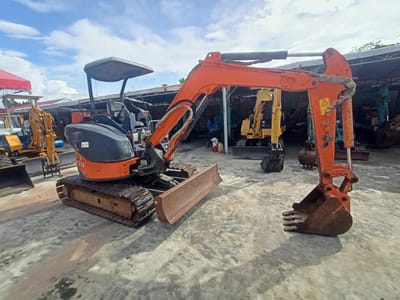
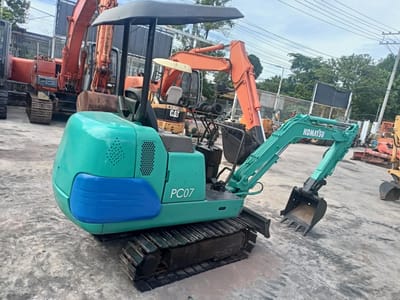
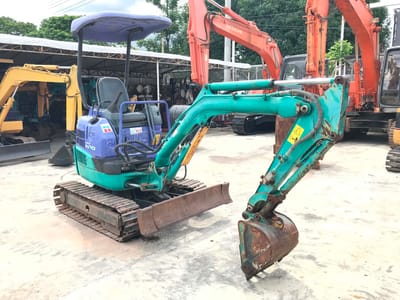
A mini excavator's total hours stay lower for longer, since compacts work fewer hours a year than mid-size machines. The same 4,000 hours means a much longer working life on a 1.5-tonne machine than on a 20-tonne one, and benchmarks written for mid-size fleets shouldn't be applied to minis without that adjustment. Our mini excavator guide covers sizes and model names.
What matters more than the meter
The work behind the hours changes what they mean. One member of Boom & Bucket's forum put it this way: 10,000 hours of light utility work is very different from 10,000 hours in a rock quarry or with a hammer. These are the checks that tell you how the hours were spent:
- Maintenance records, with dates and hours for oil, filters, and hydraulic service.
- The undercarriage: track wear, sprocket teeth, and leaking rollers.
- The hydraulics: leaks, slow cylinders, and the boom drifting down with the engine off.
- Pins and bushings: play at the boom, arm, and bucket joints.
- The swing: a clunk when it stops points to play at the swing bearing.
- Fresh paint on the boom or arm, which can hide cracks or welds.
- The wear on pedals, levers, and the seat, checked against the hours shown.
When the meter can't be trusted
An hour meter can be replaced, disconnected, or broken, and none of that shows on the display. If the hours look low for the machine's age and wear, ask when the meter was changed and look for the wear points above. Worn pins, hooked sprocket teeth, and a polished seat point to far more than 800 hours, whatever the meter shows.
Hours and price
Hours move the price within a size class. EquipmentFA's example for a Caterpillar 320DL put average use at about 800 hours a year, and doubling that to 1,600 hours a year cut the estimated five-year residual value by 17.3%. EquipBook's market data has mid-size excavators past 10,000 hours keeping 30% to 42% of their new value.